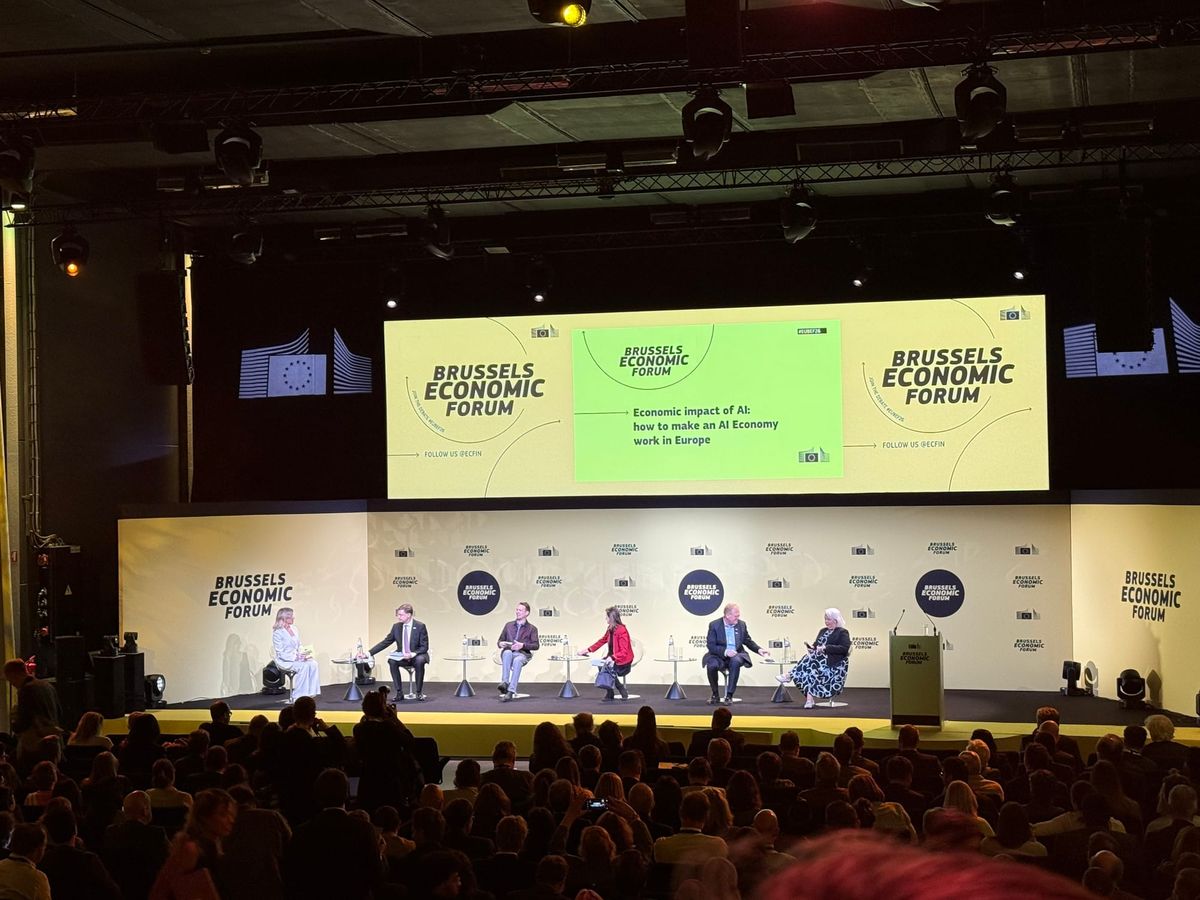
If the speakers at the Brussels Economic Forum (BEF) are indicative, Europe is stuck between fantasy and despair on the continent’s economic future, which will be governed by the AI revolution.
On one extreme is Luc Frieden, the prime minister of Luxembourg. At the BEF Mr. Frieden boldly declared that Europe can lead in AI, and does not need to accept that only the U.S. and China will be the only players. His theory is that Europe leads the world in advancement of values like freedom, democracy and the rule of law. He believes that Europe can leverage this to develop AI by Europe, for Europe, which will include regulations to advance its high-minded principles.
Others at the BEF, such as Stefan Hartung (Chairman of the Board at Bosch GmbH) were more skeptical, recognizing that the U.S. and China are so far ahead in developing AI that it will be difficult for Europe to catch up. Mr. Hartung recognized two possible scenarios: (1) that Europe loses because the U.S. and China are so far ahead; or (2) that Europe is able to play a major role by innovating the use of AI on the application side of the equation.
Phillipe Aghion (Nobel Prize winner in Economics) had a similar message to Mr. Hartung’s. He believes that AI can boost productivity in Europe, making innovation easier. But he recognizes that companies like Amazon, Google, and Microsoft are so dominant in cloud technology, that this creates a barrier to entry for anyone else to compete in creating AI technology. Professor Aghion also criticized the European tendency to mock failure, which hinders innovation. By contrast, the U.S. encourages failure which leads to more risk taking and experimentation.
Another professor, Daniel Suskind pointed how economic growth in Europe was on a par with the U.S. until the 1990’s which saw the U..S. economy take off while Europe’s did not keep up. Mr. Suskind attributes this divergence to the technology sector, and warned of the danger that Europe will fall further behind if it does not find a way to participate in the AI revolution.
A panel discussion pointed out that, if the Europe does not get on board with AI, there could be a “doomsday scenario” whereby its economy could be held hostage by the U.S. and China.
Overall, the optimistic picture painted by Prime Minister Frieden was mostly an outlier at the BEF, with most speakers having measured hope that AI can improve productivity for European countries, but few believing that Europe will be able to compete with the U.S. and China in producing AI models and developing the massive infrastructure necessary to run AI programs. Some speakers were particularly gloomy, fearing that AI will cause Europe to fall further behind economically, with AI being developed by countries not fully committed to European values. There was skepticism about whether Europe regulation can effectively mitigate against unethical and dangerous uses of AI. Sadly, not only was the U.S.’s unwillingness to regulate AI criticized, but its long-term commitment to democracy, ethics and rule of law also were questioned.
Member discussion: